Vol 203 July 19, 2023
PRE-ROLLS – THE STANDOUT CANNABIS CATEGORY
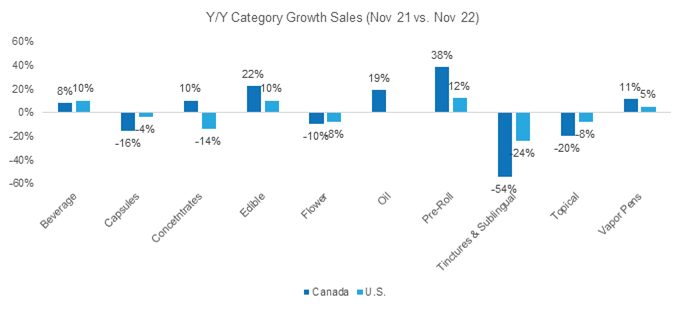
A shift away from wellness use toward recreational use, and the growing demand for infused products has made pre-rolls the fastest growing cannabis category. Pre-rolls are ready-to-go joints containing pre-grounded cannabis flowers. As with other cannabis flower products, pre-rolls come in different types of strains, such as indica, sativa, hybrid, connoisseur/infused, and cannagars/blunts, each offering a unique experience to end users. Driven by a combination of convenience, use of high-quality flowers, and reduction in packaging size, pre-rolls emerged as one of the fastest growing cannabis categories during the pandemic and this trend has continued ever since. Data from a Custom Cones USA and HeadSet report shows that pre-rolls are the fastest-growing category in both the U.S. and Canada – pre-roll sales were up 38% y/y in Canada in November 2022, the highest growth among all segments in country, and were up 12% y/y in the U.S., also the fastest growth among all segments in the country. As a result, pre-rolls went from having a 7.9% market share in 2018 to a 12.7% market share in 2022, according to Headset. One broad trend driving this rapid market share gain is the shift away from cannabis’ wellness use (through tinctures, capsules, and topicals) toward recreational use (through flower, pre-rolls, and vapes). However, there are other category-specific drivers, as well. These include:
n Growing demand for infused/connoisseur pre-rolls. Headset refers to infused products as “connoisseur” pre-rolls, which are infused with or dipped in concentrates such as wax, rosin, and other marijuana concentrates. According to the Custom Cones USA and HeadSet report, infused pre-rolls sales in Canada grew 1,426% last year, with mixed strain pre-rolls growing at 440%, and disposable vapes at 160%. Even in the U.S., connoisseur pre-rolls are among the top three segments by growth, with the other two being mixed strain and vapor pens. Retailers attribute this strong growth of infused pre-rolls to their consistent taste, high-quality products, and reasonable pricing (a single 1.5-gram, infused Catacomb pre-roll retails for $30, per Marijuana Business Daily.) Another driving factor is the higher potency (3x) of infused pre-rolls vs. normal pre-rolls.
|
Chart 1: Pre-Rolls Lead Category Growth in Both the U.S. and Canada |
|
|
Source: Intro-act, Custom Cones USA, HeadSet
n Increasing variety in sizes and packaging. Pre-rolls were historically sold as 1-gram singles; however, brands have now introduced many new sizes including half-gram pre-rolls, 1.5-gram pre-rolls, etc. Pre-rolls are being sold in two-packs, five-packs, 10-packs, and other quantities. The combination of a variety in sizes and packaging allows consumers to consumers to pair pre-rolls with occasions, thus driving their popularity. According to this Marijuana Business Daily article, smaller-sized pre-roll packs are gaining popularity, with half-gram two-packs, multipacks being among the fastest moving pre-rolls. Consumers in the U.S. prefer two- or four-packs while those in Canada prefer buying pre-rolls in bulk.
n Falling prices and advancement in pre-roll making technology. Like in all other cannabis categories, pre-rolls have also experienced pricing compression, thus making them more affordable. However, it is worth noting that that pre-roll pricing has declined the least among all segments in the U.S. and was up 5% y/y in Canada (see chart below), thus highlighting the strong consumer demand for these products. Further, the increased use of automated machinery that can efficiently produce infused pre-rolls at scale is also allowing producers to keep pre-roll costs lower and potency high, thus attracting more consumers.
|
Chart 2: The Pre-Roll Category Has Experienced Least Price Compression |
|
|
Source: Intro-act, Custom Cones USA, HeadSet
|
Chart 3: North America Pre-Roll Sales and Pricing |
|
|
Source: Intro-act, Custom Cones USA, HeadSet
With sales of $200 million+, Jeeter is by far the biggest pre-roll brand. Jeeter, owned by DreamFields, is a well-known cannabis pre-rolls brand. In 1Q21, Jeeter surpassed Sublime to become the leading infused pre-rolls brand in CA in terms of sales with a 40%+ market share. In 2022, Jeeter came in at number 144 on the Inc. 5000 list, making it one of the fastest growing companies in the world. It ranked 15th within the Consumer Products category and was 20th on the list of fastest growing California-based companies. In May 2023, Silver Spike Investment Corp. (NASDAQ: SSIC) led and participated in the $35 million initial close of a senior secured credit facility to DreamFields Brands, Inc. – we expect this capital (which comes at a time when most other operators are struggling for finance) to be deployed toward expansion of the Jeeter brand and operations, thus strengthening Jeeter’s position as the leading pre-roll brand. Other leading pre-roll brands include Lowell Herb Co, Kingpen, Pacific Stone, STIIIZY, and Presidential.
|
Chart 4: Leading Pre-Roll Brands |
||||||||||||||||||||||||||||||||||||||||||||||||||||||||||||||||||||||||||||||||||||
|
Source: Intro-act, Custom Cones USA, HeadSet. *House Brands refers to multiple companies—all of which create and sell their own pre-rolls. The sales numbers reflect the pre-roll sales in their own dispensaries.
States give marijuana data to Biden administration for rescheduling review. At least five states with medical marijuana programs have shared key data – including the products patients are using and how they are affected – with U.S. health regulators as part of the Biden administration’s review of whether to remove marijuana from the federal government’s list of the most dangerous drugs, MJBizDaily has learned. The state data sent to the U.S. Food and Drug Administration and the Department of Health and Human Services (HHS) offers federal researchers a wider and deeper look into marijuana use and its medical potential than most peer-reviewed studies available to researchers, experts told MJBizDaily. Read More (Marijuana Business Daily)
Virginia governor ‘not interested’ in legalizing adult-use cannabis sales. Virginia Governor Glenn Youngkin has stated that he is not interested in legalizing adult-use cannabis sales in the state. This comes after the state legalized recreational marijuana in 2021, but with a projected start date of January 1, 2024. Since then, Republican lawmakers have moved to cut the Cannabis Control Authority's budget and killed a retail bill. Youngkin's term as governor runs until at least January 2026, so it is unlikely that recreational marijuana sales will be legalized in Virginia during his administration. However, medical marijuana sales remain legal in the state, and the 2023 MJBiz Factbook projects sales worth as much as $43 million this year. Read More (Marijuana Business Daily)
House and Senate both move to keep blocking D.C. marijuana sales but protecting state medical cannabis laws. House and Senate appropriators have approved large-scale annual spending bills that once again include language to protect state medical cannabis programs, as well as a controversial rider to block Washington, D.C. from implementing a system of regulated marijuana sales. The Senate and House Appropriations Committee both held markups of Fiscal Year 2024 spending legislation for Financial Services and General Government (FSGG). And the Senate panel, as well as a House subcommittee, have also advanced their appropriations measures for Commerce, Justice, Science, and Related Agencies (CJS). Read More (Marijuana Moment)
Vermont’s flood-hit cannabis businesses face aid challenges amid federal prohibition. Vermont's flood-hit cannabis businesses are ineligible for federal disaster relief funds because cannabis is still illegal at the federal level. This is a major problem for many cannabis businesses, as they are already struggling to make ends meet. The Vermont Cannabis Association is calling on the federal government to provide disaster relief funds to flood-hit cannabis businesses. The article concludes by saying that the federal government's refusal to provide disaster relief to flood-hit cannabis businesses is a "clear example of the hypocrisy of the federal prohibition of cannabis." Read More (Global Cannabis Times)
June 2023 saw Connecticut and Arkansas hit record highs for its cannabis sales. In Connecticut, medical and recreational cannabis sales hit almost $24 million – and the month also saw adult use sales higher than medical sales. The adult-use market in saw $12.5 million in cannabis sales following the launch of adult use sales on January 10, 2023, and $11.3 million in medical. According to KNWA, Arkansas patients also spent $141 million in June – a new record for the state. In a statement, Arkansas’ Department of Finance and Administration spokesperson Scott Hardin stated: “With a sales average of $23.5 million monthly, we should surpass $1 billion in overall sales toward the end of this year.” Read More (Business of Cannabis)
Michigan marijuana sales hit record high of $261 million in June, state data shows. Michigan marijuana sales hit another record high in June, reaching nearly $261 million. Adult-use cannabis purchases accounted for the majority of the total, at $254,153,133. Medical marijuana sales were at $6,643,877. This beats the prior record set in March by more than $10 million. Most of the cannabis purchases came from flower, followed by vape cartridges and infused edibles, the Michigan Cannabis Regulatory Agency (CRA) data, first reported by New Cannabis Ventures, shows. The state is seeing these record-setting sales even as the average cost of marijuana has remained at record lows, with the price of an ounce for adult-use cannabis now hovering around $90. Read More (Marijuana Moment)
Michigan wholesale marijuana prices stabilize for now after steep drop. Wholesale marijuana flower prices in Michigan have leveled off and ticked upward in recent months, offering cause for cautious optimism among producers who suffered as prices plummeted during the past few years. At the pinnacle of wholesale prices in February 2020, the average price per pound of flower was $3,883, according to sales data provided by New York-based cannabis wholesale platform LeafLink. Michigan wholesale prices have yet to return to such lofty heights. By February 2021, the average per-pound price for flower had crashed by 61% to roughly $1,510, LeafLink’s data shows. Prices fell another 29% to $1,075 by February 2022, then slipped 27% year-over-year to $789 by February 2023. For now, flower prices are on the upswing: The average per-pound wholesale price grew to $832 in April, $907 in May and $963 in June. Read More (Marijuana Business Daily)
|
Chart 5: Michigan Wholesale Marijuana Flower Prices (Per Pound) |
|
|
Source: Intro-act, Marijuana Business Daily, LeafLink, Datawrapper
Maryland’s combined cannabis sales hit $21 million in first week of adult use. Maryland marijuana retailers sold nearly $21 million in medical and recreational cannabis products combined in the state’s first week of adult-use sales. Andrew Garrison, the chief of policy and government affairs for the Maryland Cannabis Administration, told Salisbury TV station WMDT: “The opening weekend was about $10 million, and $5 million of that was on the first day alone.” And further added: “That’s pretty consistent with what we see in other states.” The 2023 MJBiz Factbook forecasts that recreational cannabis sales in Maryland could reach $275 million this year and $2.1 billion by 2027. Read More (Marijuana Business Daily)
Adult-use cannabis sales in Maine reach new record in June. Adult-use cannabis sales in Maine reached a new record in June, topping $18.4 million, according to Maine Office of Cannabis Policy (OCP) data outlined by the Bangor Daily News. The previous high was $17.4 million, realized the previous month. In all, dispensaries in the state sold about 5,270 pounds of cannabis in June. Cannabis was legalized in Maine by voters in 2016 but retail sales didn’t commence in the state until July 2022. According to OCP data, there were 322,169 transactions at adult-use dispensaries in June, with an average flower price-per-gram of $7.69. So far this year, adult-use sales have totaled $97,408,138 in 1,671,054 transactions. If sales remain on this pace, 2023 adult-use sales in Maine will surpass last year’s total of $158.9 million. Read More (Ganjapreneur)
Massachusetts marijuana sales hit new record high of $152 million in June. Massachusetts marijuana sales reached nearly $152 million in June—a record monthly high since the state’s adult-use market launched in November 2018—state data shows. The Cannabis Control Commission (CCC) reported that recreational cannabis sales hit $132.8 last month, while medical marijuana purchases amounted to $19 million. The state has now seen $4.74 billion in adult-use sales since the market opened five years ago. Flower products remained the most popular choice for adult consumers, followed by vape products, pre-rolls, edibles and concentrates. The average price of flower cannabis also dropped to a record low of $5.82 per gram last month, according to the CCC data. Read More (Marijuana Moment)
|
Chart 6: Massachusetts Marijuana Sales Dashboard |
|
|
Source: Intro-act, Marijuana moment, Tableau
Michigan ends preemployment cannabis testing for most state employees. The Michigan Civil Service Commission voted unanimously to end preemployment cannabis testing for most state employees. The new policy will go into effect on October 1, 2023, and will affect about 60,000 state employees. The decision was made in response to research that suggests that cannabis use does not impair job performance. The policy change does not apply to employees in safety-sensitive positions, such as those who operate heavy machinery. This is a significant step forward for cannabis reform in Michigan, and it is likely to have a ripple effect in other states. Read More (Ganjapreneur)
Rhode Island marijuana officials launch listening tour. The Rhode Island Cannabis Control Commission (CCC) is launching a listening tour to gather input from the public on how to regulate the state’s recreational marijuana industry. The tour will begin on July 11 and will include stops in Providence, Newport, and Woonsocket. The CCC is seeking feedback on a variety of topics, including licensing, product testing, and social equity. The commission is also interested in hearing from people who have been disproportionately impacted by the War on Drugs. The listening tour is part of the CCC’s efforts to develop a comprehensive regulatory framework for the state’s recreational marijuana industry. Read More (Marijuana Moment)
Many cannabis crops grown in Washington County are contaminated with banned pesticide, regulator finds. The Washington State Liquor and Cannabis Board (LCB) announced that most cannabis crops grown in the Okanogan County area of Washington are contaminated with a banned pesticide, dichlorodiphenyldichloroethylene (DDE). DDE is a by-product of the pesticide DDT, which was banned in the U.S. in 1972 due to the threat it posed to wildlife. Out of 108 product samples submitted, 61 products (56%) tested above the 0.1 action limit for DDE. The LCB is working with state agencies to conduct soil and water testing in the Okanogan region to determine the source of the contamination. Read More (Analytical Cannabis)
New York raids unlicensed cannabis club, court battles expected. In a recent development, law enforcement authorities in New York conducted a raid on an unlicensed cannabis club. The club, located in the city, was targeted as part of ongoing efforts to crack down on illegal cannabis operations. The raid resulted in the seizure of a significant amount of cannabis and related products. The club's owners are expected to face legal battles in court as a consequence of the raid. Law enforcement agencies are actively working to curb the illicit cannabis market and enforce regulations in the state. Read More (Global Cannabis Times)
Oregon regulator recalls flower due to arsenic risk. A regulatory body in Oregon has issued a recall for a specific batch of cannabis flower due to potential health risks associated with arsenic contamination. The recall was prompted by laboratory test results that detected higher than acceptable levels of arsenic in the flower. The contaminated batch was distributed to several dispensaries in the state. The regulatory agency advises consumers who purchased the affected product to return it to the point of purchase. This recall serves as a reminder of the importance of rigorous testing and quality control measures within the cannabis industry to ensure consumer safety. Read More (Analytical Cannabis)
Delaware taps NCS Analytics to help monitor marijuana tracking system. Delaware has entered into a partnership with NCS Analytics to bolster its marijuana tracking system monitoring capabilities. The state has chosen NCS Analytics, a leading provider of data analytics and compliance solutions, to help ensure effective oversight and regulation of its cannabis industry. NCS Analytics will assist Delaware in monitoring the entire supply chain, including cultivation, manufacturing, distribution, and retail operations. By leveraging advanced data analytics, the partnership aims to enhance transparency, detect anomalies, and improve compliance within the state's legalized marijuana market. Read More (Marijuana Business Daily)
August 2023 implied forward unchanged at $1,075 per pound. At $1,075 per pound, the August 2023 implied forward represents a premium of 5.4% relative to the current U.S. spot price of $1,020 per pound. The U.S. wholesale spot index has fallen in four of the last five weeks after staging a successful rally from March until the first week in June. The rally fizzled as legacy states – specifically California, Oregon, and Colorado – started selling off in early to mid-June. Of the legacy states, only Washington State’s spot price is trading sideways as opposed to lower. The Southwest “Sand States” continue to see Nevada and New Mexico trading at a premium to Oklahoma and Arizona. Read More (Cannabis Benchmarks)
|
Chart 7: Cannabis Benchmarks U.S. Spot Weighted Avg (Week Ending July 14, 2023) |
|
|
Source: Intro-act, Cannabis Benchmarks, New Leaf Data Services
Ontario Cannabis Store joins calls to raise Canada’s THC edibles cap. The Ontario Cannabis Store (OCS) launched a multi-channel awareness campaign on July 10 aimed at expanding cannabis literacy among Ontarians through the Cannabis Made Clear online education hub. Cannabis Made Clear provides easy access to unbiased, fact-based, and current resources to support cannabis consumers and canna-curious Ontarians in making informed, responsible choices about cannabis. David Lobo, President & CEO, OCS says, ““Five years into legalization in Canada, combatting misinformation and presenting the facts about cannabis remains critically important to enabling a vibrant cannabis marketplace. Read More (Cannabis Retailer)
Trulieve expands to Ohio. Trulieve Cannabis opened its first medical marijuana dispensary in Ohio. Fellow MSO Ayr Wellness is also expanding in the state. Ayr said it signed an option agreement to acquire 100% of the equity interest of Twice the Wellness, a dispensary in Cleveland suburb Woodmere, according to a separate release. The terms of the agreement were not disclosed. It’s Ayr’s third option agreement to acquire dispensaries in Ohio, where it previously announced agreements to acquire Daily Relief in Riverside, near Dayton, and Heaven Wellness in Clermont County, near Cincinnati. All three dispensaries are scheduled to open before the end of the year. Read More (Marijuana Business Daily)
Green Thumb CEO Ben Kovler explains why his marijuana MSO is in the black. Green Thumb Industries (GTI) has reported being profitable and "in the black" for the first time since its establishment. The company attributes its success to strategic decisions and a focus on operational efficiency. GTI's strong financial performance is driven by increasing revenue from its retail operations, expansion into new markets, and cost-control measures. The MSO has demonstrated consistent growth, with plans for further expansion and acquisitions. GTI's achievement of profitability underscores the potential for success within the cannabis industry and highlights the importance of effective management and execution in this evolving market. Read More (Marijuana Business Daily)
Gold Flora and The Parent Company complete transformational merger. Gold Flora Corporation announced the completion of the previously announced business combination transaction resulting in the combination of TPCO Holding Corp. (The Parent Company), and Gold Flora, LLC in an all-stock merger. The merged entity, which now operates as Gold Flora Corporation, creates a leading portfolio encompassing cultivation, distribution, product brands, and retail and delivery footprint – enabling the business to operate at scale across California and control every aspect of the rapidly evolving supply chain. Read More (Newswire)
Fawn River Cultivation Company and BioLumic unleash a New Era of cannabis varieties in Michigan. Fawn River Cultivation Company and BioLumic announced a new partnership to redefine cannabis cultivation in Michigan using BioLumic’s patented UV light technology, opening the door for new varieties to hit the consumer market by the end of 2023. Through this partnership, Fawn River will deploy BioLumic’s propagation-stage light recipes to regulate cannabinoids and terpenes profiles to develop a wider and more compelling range of consumer products and consumer wellness benefits. John Babcock, CEO, Fawn River Cultivation Company, said: “Michigan consumers deserve more varieties with a greater value at every price point.” Read More (Yahoo)
Organigram posts CAD $213.5 million loss, frets over THC inflation. Organigram Holdings posted a net loss of CAD $213.5 million ($162.1 million) for its third quarter, driven by a CAD $191.2 million impairment loss. Total net revenue for the quarter was CAD $32.8 million, a decline of 14% from the same quarter last year and a sequential decline of 17% from Organigram’s second quarter. Organigram CEO Beena Goldenberg attributed the weaker quarterly financial results to: lower-than-expected growth in the flower category, delayed international cannabis shipments, and the company’s inability to sell its Edison Jolts cannabis lozenge product in light of a disputed decision by regulator Health Canada. Read More (Marijuana Business Daily)
Avant Brands reports Q2 fiscal 2023 results with record revenues and positive EBITDA. For the second quarter ended May 31, 2023 (Q2 2023), Avant brands reported gross revenues of $9.0 million, which is a record quarter for the company (+101% y/y or +$4.5 million). Total net revenues for the period were $8.0 million (+96% y/y or +$3.9 million), which includes recreational net revenue of $4.8 million (+53% y/y or +$1.6 million) and export-B2B net revenue of $3.2 million (+311% or +$2.4 million). The company further reports adjusted EBITDA of $1.7 million (+$2.7 million from Q2 2022) and adjusted EBITDA margin of 21% (vs. -26% during Q2 2022). The company further reported an adjusted net loss of $0.28 million, (a decrease of 86% y/y or $1.7 million). Read More (Mailchi)
Celebrity marijuana brands outperform traditional brands, data suggests. Celebrity brands in the California market – including Cann, Houseplant and Mirayo by Santana – outsold traditional marijuana brands by a healthy margin in the first quarter, according to data compiled by Headset. And in terms of price point, celebrity brands actually tend to charge less than the $23.14 per item that traditional cannabis brands do, according to Headset data. The snapshot of the first three months of 2023 compared 20-plus celebrity brands against a representative sample that included more than 1,300 traditional marijuana brands. Traditional brands in the first quarter averaged $26,591 in monthly sales, according to Headset. At least nine celebrity brands exceeded that figure, with five generating monthly revenue well above the $100,000 mark. Read More (Marijuana Business Daily)
|
Chart 8: Celebrity Marijuana Brands in California |
|
|
Source: Intro-act, Marijuana Business Daily, Headset, Datawrapper
Debt raises decline as effective cost of capital increases. Cannabis companies issued a record amount of debt in 2021, including six of the ten largest debt deals in U.S. cannabis history. The pace declined in 2022, but low debt costs and strong access to debt capital kept the spigot open. The first half of 2023, however, has seen a sharp reduction, with sequential quarter issuance down 78%. There are several reasons for the downturn in debt issuance. 1) MSOs have reduced capital spending and cash used in acquisitions in response to challenged capital markets. 2) Many MSOs have essentially maxed out their debt-carrying capacity. 3) Also, as the orange line on the graph indicates, the effective cost of debt has risen significantly since the first half of 2022, making debt less attractive to issuers. Read More (Viridian Capital Advisors)
|
Chart 9: The U.S. Cultivation Debt Issuance Vs. Effective Cost % |
|
|
Source: Intro-act, Viridian Capital Advisors
Canopy Growth to pay cash and issue 90.4 million shares to reduce debt. Canopy Growth announced that it has entered into a series of agreements, including privately negotiated redemption agreements with certain holders of its unsecured senior notes due July 15, 2023 and agreements with certain of its lenders under its term loan credit agreement dated March 18, 2021, that will have the overall effect of deleveraging the company’s balance sheet. highlights include: 1) total debt reduction: ~ $437¹ million expected over the next 2 quarters, 2) annualized interest expense savings: ~ $20 – $30 million, 3) discount capture: repayment of principal owing under the credit agreement between 93% and 95% of par, 4) elimination of call premium: ability to prepay remainder of loan at par, and 5) enhanced equity capitalization: conversion of ~ 41% of existing notes into common shares. Read More (New Cannabis Ventures)
Alleged marijuana stock pump-and-dumper agrees to fine, trading ban. A federal judge ordered an alleged co-conspirator in a marijuana stock pump-and-dump scheme to pay a fine of more than $150,000, court records show but without an admission of any guilt. David Ferraro, who allegedly worked with previously convicted Justin Costello to promote microcap stocks, also “conducted his own stock promotion scheme,” according to U.S. Securities and Exchange Commission attorneys. Ferraro netted total profits from these stock-promotion schemes in excess of $109,000, the SEC alleged. In a final judgment in the case against Ferraro, entered in federal court on July 11, he avoided civil penalties and admission of guilt. However, Ferraro agreed to be “permanently barred” from future involvement in any penny stocks, court records show. Read More (Marijuana Business Daily)
Republican resistance ends medical cannabis legalization push in NC. Efforts to legalize medical cannabis in North Carolina have been halted due to Republican resistance. Despite bipartisan support, Republicans opted not to include a provision for medical marijuana legalization in the state's budget bill. This decision comes as a disappointment to advocates who had hoped to expand access to medical cannabis for patients with qualifying conditions. The resistance from Republican lawmakers highlights the ongoing divisions within the party regarding cannabis reform. Nonetheless, proponents remain hopeful that future endeavors to advance medical cannabis legislation in North Carolina will gain traction as support for cannabis reform continues to grow nationwide. Read More (Marijuana Business Daily) and More (Cannabis Business Times)
Minnesota adds qualifying conditions for medical cannabis program. Minnesota has expanded its medical cannabis program by adding qualifying conditions for patients. The state's Department of Health approved the inclusion of six new conditions, including sickle cell disease, chronic vocal or motor tic disorder, severe insomnia, and autism with self-injury or aggression. This decision aims to provide broader access to medical cannabis for patients in need. The inclusion of these conditions reflects ongoing efforts to expand the range of medical conditions eligible for treatment with cannabis-based therapies. Read More (Marijuana Business Daily)
Arkansas medical marijuana sales eclipse $141 million in first half of 2023. Medical marijuana retailers in Arkansas improved sales and product volume in the first six months of the year. Retailers generated $141 million in sales through June, a 5% increase from the same period last year, according to the latest statistics from the state’s Department of Finance and Administration. Medical Marijuana dispensaries sold 29,057 pounds of cannabis, up 23% year-over-year. Sales and product volume in the first half of 2023 were on pace to break last year’s record of $276 million in sales and 50,547 pounds sold. Arkansas has 94,373 active cardholders through July 8. Read More (Marijuana Business Daily)
New Hampshire allowing reciprocity for medical cannabis patients. New Hampshire has introduced a reciprocity program that allows individuals with valid medical cannabis cards from other states to access and purchase medical cannabis within the state. The program aims to provide uninterrupted access to medical cannabis for out-of-state patients while they are in New Hampshire. However, certain guidelines and restrictions regarding the types and quantities of cannabis allowed under reciprocity will apply. The implementation of this program reflects the state's commitment to improving patient care and expanding access to medical cannabis for individuals who require it. Read More (Ganjapreneur)
New private entity tasked with reviewing prospective medical cannabis businesses. The Alabama Medical Cannabis Commission held its first meeting since it decided to pause and void the business license awards process. The commission found inconsistencies in the data and now faces multiple lawsuits over the ethics of the application process. The accounting firm KMPG will now review the business license applications. This comes after the original scores were done by anonymous graders hired by the University of South Alabama. Some commission members say the outsourcing of the grading is the problem. Multiple commission members recommended stopping the external review of the applications and require the commission to review and score the applications themselves. Read More (WSFA12 News)
How did hemp CBD & THC sales kick off 2023? CBD product sales reported by publicly traded companies continued to steady, and in some cases even saw small improvements in the opening period of 2023. Still, familiar headwinds persist for the industry as hopes that CBD could be regulated in the U.S. via Congressional action appear to be fading. On the hemp-derived THC front, sales also appear to be stabilizing and in some cases slowing. Yet at least one company is touting plans for growth, though the possibility persists that federal lawmakers will act to regulate, limit, or potentially even prohibit the sector later this year. CBD company sales are currently steady, but downtrend perists amidst familiar headwinds. Read More (Hemp Benchmarks)
FDA, FTC issue new round of warnings over hemp-derived synthetic THC. Six companies in five states have received warning letters from government agencies for selling illegal products containing delta-8 THC made from industrial hemp. The U.S. Food & Drug Administration (FDA) and the Federal Trade Commission (FTC) targeted the companies for their online sales of products containing the synthetic form of THC. Individuals and companies that received joint warning letters from the FDA & FTC, includes: 1) Diane R. Becker, North Carolina Hemp Exchange (dba NC Hemp Shoppe, Raleigh, NC), 2) Cindy Barton, The Haunted Vapor Room (Frankin, NJ), 3) Efrain Villalobos, Nikte’s Wholesale (Albuquerque, NM), 4) Ilham Mansi, Dr. Smoke (aka Dr. S., Kansas City, MO), 5) Exclusive Hemp Farms (OShipt.com, Gilroy, CA), and 6) Radiant Hoang, Delta Munchies (Los Angeles, CA). Read More (Hemp Today)
Illinois awards 55 more adult-use marijuana retail licenses. Illinois regulators awarded an additional 55 marijuana adult-use retail licenses in a lottery, aiming to create a more equitable industry and expand access to regulated cannabis. Nearly 2,700 applicants were hoping to snag one of the conditional recreational retail licenses, which were reserved for entrepreneurs who meet the state’s social equity criteria, according to the Country Herald of Bourbonnais. The criteria include being from a community that was disproportionately impacted by cannabis prohibition or someone having a record of low-level marijuana-related charges. Of the 192 social equity licenses that were previously awarded, only 27 stores had opened as of July 11, according to Green Market Report. Read More (Marijuana Business Daily)
Cannabis edibles surge in popularity in 2023. Mirroring the expanding cannabis market, the industry’s offerings of cannabis edibles have also expanded. With new and innovative cannabis edibles appealing to a broader audience, legal edibles are surging in popularity. Edibles also have the advantage of being a more discreet and convenient way to consume cannabis. They don’t produce any smell and are typically travel-sized so that you can take them on the go. Smoking cannabis can provide fast-acting effects, while edibles typically have a longer onset time. However, the effects of edibles last much longer. One of the most significant benefits of THC edibles is that they provide long-lasting and potent effects. While cannabis beverages usually have effects that last for 1 to 3 hours, edibles typically last 6 to 8 hours. Read More (CannabisTech.com)
Safe Harbor brings interest to cannabis accounts. Safe Harbor Financial has launched interest-bearing commercial deposit accounts for cannabis businesses nationwide. The product offering addresses the industry’s unmet need for interest-bearing options, which many smaller banks and credit unions currently do not provide. Through a strategic partnership with a proprietary financial institution, Safe Harbor says it can now offers cannabis businesses the opportunity to earn interest income without any maximum balance limitations. Sundie Seefried, CEO of Safe Harbor, said in a statement: “Interest-bearing accounts are especially important to large depositors in the current banking climate, and we’re proud to be able to offer our clients more of the important financial and treasury tools that they need to grow and protect their businesses.” Read More (Global Cannabis Times)
Ukraine draft medical cannabis law passes first hurdle. A majority of Ukraine’s parliament voted in favor after the first reading of a draft law to establish the legal footing for medical cannabis production and distribution in the Eastern European nation. According to The Kyiv Independent, the draft received support from 268 of parliament’s 405 lawmakers. The bill might undergo further revisions as parliament’s scrutiny of the draft law continues. A second vote needs to be held before it can reach the desk of President Volodymyr Zelenskyy for final approval. In June, Zelenskyy urged parliament to work faster on the pending law, which has been stalled for two years. Read More (Marijuana Business Daily)
Germany’s ‘Impractical’ And ‘Contradictory’ draft law is driving would-be cultivation associations to put plans on ice. Germany’s highly anticipated draft law for ‘Pillar 1’ of its cannabis legalisation plans has been hammered by industry stakeholders and would-be associations. The new proposals, published officially for the first time, have been accused of significant ‘over-regulation’, which would make it all but impossible for cannabis associations to operate. One would-be cannabis association told Business of Cannabis its plans have now been put on ice following the publication of the draft law, calling the stipulations ‘crazy’. Kai-Friedrich Niermann, cannabis lawyer and industry expert, said of the draft bill: “The basic idea of the so-called Pillar 1 is based exclusively on health aspects, namely the protection of children and young people. This is placed above everything else, and leads to a downright health policy alarmism.” Read More (Business of Cannabis)
Portugal: all roads lead to legalisation, but when? The legalisation of cannabis in Portugal has been a long and winding road, which has been traveled for more than a decade, with the Bloco de Esquerda (BE) leading the odyssey to reach the much-desired destination. However, in recent years, almost all parties have been converging in the same direction, albeit with different ideologies. BE and IL (Liberal Initiative) have appointed September as the month to start the discussion in Parliament, but nothing has yet been confirmed. Is this the year when white smoke comes out of the Assembly of the Republic? Read More (Business of Cannabis)
Rhode Island dispensary sues over labor-peace requirements for cannabis licenses. A Rhode Island cannabis dispensary has filed a lawsuit over labor peace agreement provisions in the state’s cannabis legalization law, the Boston Globe reports. Greenleaf Compassionate Care Center argues that it was “coerced into entering an oppressive collective bargaining agreement” because of the 2022 law. The law included requirements that licensed cannabis dispensaries in the state enter into “labor peace agreements” with a “bona fide labor organization” even if the business existed prior to the law’s passage. Greenleaf has been a licensed medical cannabis dispensary in the state since 2013. Read More (Ganjapreneur)
Wrigley wins lawsuit to keep Skittles name off marijuana products. The makers of the popular marijuana strain Zkittlez, which borrowed its name from a trademark owned by confectioner Wrigley, will discontinue the product line after bowing to legal pressure from the candy giant. In a settlement proposed on June 28, Terphogz agreed to stop using names, websites and advertising slogans that too closely resemble what Wrigley uses to sell its Skittles candy. The Wrigley Co. is a subsidiary of Mars Wrigley. Representatives of Wrigley and Terphogz did not immediately respond to requests for comment from Reuters, which first reported the proposed settlement. Read More (Marijuana Business Daily)
Amendments to loosen military’s cannabis rules added to must-pass National Defense Bill. Florida Rep. Matt Gaetz (R) has introduced an amendment to the National Defense Authorization Act (NDAA) that would end cannabis testing for military members, USA Today reports. The NDAA is a must-pass measure that reauthorizes military programs. The proposal would end cannabis testing at the time of enlistment or when soldiers are being commissioned as an officer. In 2017, the Army relaxed the process for granting waivers for cannabis consumption as it faced an increased demand for new soldiers. Additionally, the Congressional Cannabis Caucus proposed an amendment that would allow Department of Veterans Affairs physicians to recommend cannabis as a treatment to patients in states where it is legal for medical use. Read More (Ganjapreneur)
California cannabis companies tied to fake union could lose their licenses. At least a dozen California cannabis businesses that signed required agreements with a labor union now deemed illegitimate – including collapsed distribution giant Herbl – are at risk of losing their licenses, state regulators said. California law requires marijuana businesses to sign a labor peace agreement with a “bona fide” labor organization before they are issued a state license. But in an apparent effort to flout worker-friendly marijuana legalization laws and benefit businesses seeking labor cost savings, cannabis businesses across the country are signing these agreements with “labor organizations” that have few or no members and no intent to organize workers, critics charge. Read More (Marijuana Business Daily)
Facebook parent Meta updates hemp, CBD ad rules, but curbs remain. Meta Platforms, the company behind Facebook and Instagram, updated its advertising policy for hemp and CBD products, although ads for CBD products remain heavily restricted. The new policy does permit “the promotion of legally permissible, non-ingestible CBD in the U.S., with some restrictions,” according to Meta’s July 11 announcement. Without written permission, Meta advertisers can promote or offer to sell hemp products “that don’t contain CBD or >0.3% THC in Canada, Mexico and the U.S., provided they comply with all applicable local laws, required or established industry codes, guidelines and licenses.” Read More (Marijuana Business Daily)
The 5 biggest problems faced by cannabis social equity founders. 1) Capital: even with a cannabis business license in hand, social equity founders face a tremendous hurdle: financing their business plan. 2) Connections: connections are important in any business, and they represent another challenge that cannabis social equity founders often must navigate. 3) Contracts: the path to success for marijuana companies rests on paperwork – more of it than mainstream businesses face. 4) Taxes: because taxes are collected federally as well as on the state level, federal prohibition has an enormous impact on how marijuana brands settle their accounts at the end of the year. 5) Long-term resources: A misstep on something as routine as a contract or taxation can not only mean lost revenue or human resources, but it also can result in the loss of a business license. Read More (Marijuana Business Daily)
Hemp on par with wood in ability to capture and store greenhouse gas. Hemp can store CO2 as efficiently as wood in raw materials for the construction industry, and should meet EU certification criteria for carbon credits, a new report from Germany suggests. The circular economy action plan of the EU aims to cut the carbon footprint of buildings through “circular renovation” initiatives that promote green infrastructure and the use of organic building materials that can store carbon. A total of 939 million tons of greenhouse gas were emitted by European states in the fourth quarter of 2022, a 4% decrease compared to Q4 2021, when 978 million tons were released, according to Eurostat. The construction industry contributes an estimated 5 to 12% of member state CO2 emissions. The EU has a goal of reaching climate neutrality by 2050. Read More (HempToday)
|
Chart 10: Adult-Use Cannabis Sales Have Generated $15 Billion in State Tax Revenue |
|
|
Source: Intro-act, Marijuana Policy Project, Cannabis Business Times
|
Closing Price (7/14/23) |
$1.79 |
1 Week NAV Change |
0.09 (0.56%) |
NAV Change (YTD) |
-35.39% |
|
AUM (as of 7/14/23) |
$15.53 Mn |
Fund Inception |
7/8/2019 |
Expense Ratio |
0.75% |
THCX: the pure-play ETF solution for investing in cannabis. Supported by favorable regulatory trends, increasing use cases and growing public acceptance, cannabis is one of the fastest growing current investment themes. To put the opportunity into perspective, the global cannabis market is estimated to reach $630 billion by 2040. THCX was constructed to make investing in cannabis easier by helping investors get exposure to a basket of stocks that are expected to benefit from growth of the hemp and legal marijuana industries. THCX is a fund focusing mainly on North American cannabis companies, specifically in the U.S. and Canada. The initial universe of Index constituents consists of publicly listed Cannabis Companies that are involved in the legal cannabis industry. “Cannabis” is defined as (i) marijuana (or products derived from marijuana) and (ii) hemp (or products derived from hemp, which includes CBD-based products (i.e., products that contain cannabidiol).
|
One Month |
Three Months |
YTD |
One Year |
Inception |
|
-0.58% |
-20.47% |
-34.29% |
-53.17% |
-92.39% |
|
One Month |
Three Months |
YTD |
One Year |
Inception |
|
-0.58% |
-20.47% |
-33.98% |
-53.17% |
-92.39% |
|
Ticker |
CUSIP |
Company |
% of Fund |
Quantity |
|
IIPR |
45781V101 |
Innovative Industrial Properties |
7.70% |
14,919 |
|
AFCG |
00109K105 |
AFC Gamma Inc |
7.67% |
87,107 |
|
SMG |
810186106 |
The Scotts Miracle-Gro Co |
7.14% |
15,983 |
|
GRWG |
39986L109 |
GrowGeneration Corp |
6.18% |
2,53,089 |
|
CRDL |
14161Y200 |
Cardiol Therapeutics Inc/CAD/ |
6.08% |
11,50,335 |
|
CRON |
22717L101 |
Cronos Group Inc |
5.35% |
4,30,820 |
|
REFI |
167239102 |
Chicago Atlantic Real Estate |
5.34% |
52,130 |
|
MAPS |
92971A109 |
WM Technology Inc |
5.00% |
7,45,970 |
|
HITI |
42981E401 |
High Tide Inc /CAD/ |
4.90% |
5,50,778 |
|
PKI |
714046109 |
Revvity Inc |
4.62% |
5,695 |
For more information on THCX visit: https://thcxetf.com/fund/
|
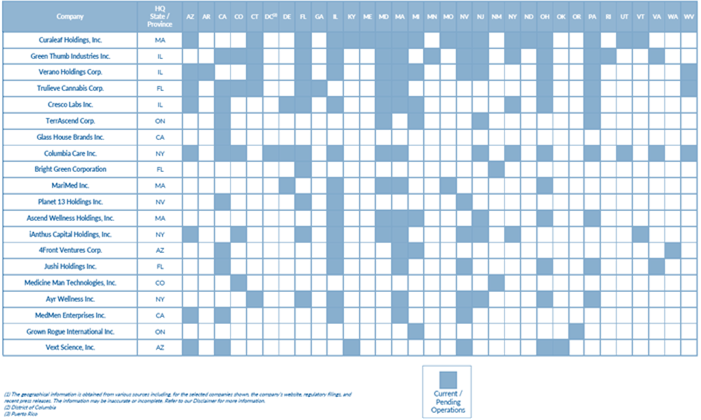
Chart 11: Select Company Geographical Footprint: U.S. Operators |
|
|
Source: Intro-act, Bryant Park Capital
|
Chart 12: Weekly Summary (July 3 – July 7, 2023) |
||||||||||||||||||||||||||||||||||||||||||||||||||||||||||||||||||||||||||||||||||||||||||||||||||||||||||||||||||||||||||||||||
|
EQUITY RAISES
DEBT RAISES
MERGERS & ACQUISITIONS
|
||||||||||||||||||||||||||||||||||||||||||||||||||||||||||||||||||||||||||||||||||||||||||||||||||||||||||||||||||||||||||||||||
Source: Intro-act, Viridian Capital Advisors
|
Chart 13: Cannabis Capital Raises by Week (2022 and 2023) |
|
|
Source: Intro-act, Viridian Capital Advisors
|
Chart 14: Cannabis M&A by Week (2022 and 2023) |
|
|
Source: Intro-act, Viridian Capital Advisors
|
Chart 15: Cannabis Benchmarks U.S. Spot Index (Vol. Wtd. Avg.) (Week Ending July 14, 2023) |
|
|
Source: Intro-act, Cannabis Benchmarks Price Index
|
Chart 16: U.S. Implied Forward Prices (Week Ending July 14, 2023) |
|
|
Source: Intro-act, Cannabis Benchmarks Price Index
|
Chart 17: Canada Cannabis Spot Index (Week Ending July 14, 2023) |
|
|
Source: Intro-act, Cannabis Benchmarks Price Index
|
Chart 18: Best-Selling Flower Brands and Products in British Columbia |
|
|
Source: Intro-act, Headset
|
Chart 19: Best-Selling Edibles Brands and Products in British Columbia |
|
|
Source: Intro-act, Headset
|
Chart 20: Best-Selling Pre-Rolls Brands and Products in British Columbia |
|
|
Source: Intro-act, Headset
|
Chart 21: Best-Selling Beverage Brands and Products in British Columbia |
|
|
Source: Intro-act, Headset
|
Chart 22: Best-Selling Concentrates Brands and Products in British Columbia |
|
|
Source: Intro-act, Headset
|
Chart 23: Best-Selling Topical Brands and Products in British Columbia |
|
|
|
Chart 24: Cannabis Company Events Calendar – Upcoming Conference Calls
|
Source: Intro-act, New Cannabis Ventures
|
Chart 25: Cannabis Company Events Calendar – Recent Conference Calls
|
Source: Intro-act, New Cannabis Ventures
|
Chart 26: Cannabis IPO Pipeline
|
Source: Intro-act, New Cannabis Ventures
|
Chart 27: Cannabis SPAC Pipeline
|
Source: Intro-act, New Cannabis Ventures
|
Chart 28: Cannabis Industry Events Calendar
|
Source: Intro-act, Cannabis Business Times
|
|
|
|
Share Price |
Mkt Cap (Mns) |
Ent Val (Mns) |
Price Performance |
Sales |
EBITDA |
Book Value |
|||||||
|
|
|
07/17/23 |
% to High |
% to Low |
% YTD |
LTM |
NTM |
EV/Sales |
LTM |
NTM |
EV/ EBITDA |
Book/ Share |
P/ |
|||
|
Peer Set |
|
|
|
|
|
|
|
|
|
|
|
|
|
|
|
|
|
Canadian LPs |
|
|
3,304 |
3,014 |
|
|
-45% |
|
|
|
|
|
|
|
0.8 x |
|
|
1 |
TLRY |
1.69 |
1,112 |
1,310 |
203% |
-11% |
-37% |
612 |
653 |
2.0 x |
51 |
71 |
18.6 x |
5.51 |
0.3 x |
|
|
2 |
CGC |
0.37 |
234 |
680 |
1176% |
-7% |
-83% |
314 |
289 |
2.4 x |
(254) |
(156) |
- |
1.08 |
0.3 x |
|
|
3 |
SNDL |
1.42 |
370 |
317 |
154% |
-12% |
-32% |
675 |
|
|
(6) |
|
|
3.83 |
0.4 x |
|
|
4 |
HEXO |
0.71 |
175 |
|
440% |
-7% |
304% |
91 |
|
|
|
|
|
2.39 |
0.3 x |
|
|
5 |
ACB |
0.53 |
188 |
156 |
266% |
-7% |
-43% |
175 |
|
|
(20) |
5 |
34.1 x |
1.04 |
0.5 x |
|
|
6 |
CBWTF |
0.01 |
14 |
140 |
428% |
-36% |
-9% |
96 |
110 |
1.3 x |
(9) |
(1) |
- |
0.06 |
0.2 x |
|
|
7 |
OGI |
1.49 |
120 |
81 |
241% |
-2% |
-53% |
120 |
127 |
0.6 x |
8 |
4 |
20.2 x |
2.76 |
0.5 x |
|
|
8 |
CRON |
1.85 |
705 |
(131) |
95% |
-10% |
-27% |
87 |
100 |
-1.3 x |
(77) |
(47) |
- |
2.97 |
0.6 x |
|
|
9 |
ALEAF |
0.01 |
6 |
40 |
390% |
-5% |
-68% |
43 |
|
|
|
|
|
(0.02) |
-0.9 x |
|
|
10 |
TGODF |
0.14 |
23 |
61 |
603% |
-11% |
-45% |
|
|
|
|
|
|
0.74 |
0.2 x |
|
|
11 |
ROMJF |
0.35 |
20 |
22 |
172% |
-27% |
-36% |
39 |
54 |
0.4 x |
4 |
9 |
2.6 x |
0.50 |
0.7 x |
|
|
12 |
FLGC |
2.45 |
340 |
338 |
937% |
-6% |
-46% |
56 |
|
|
(17) |
|
|
0.39 |
6.2 x |
|
|
|
|
|
|
|
|
|
|
|
|
|
|
|
|
|
|
|
|
|
|
Share Price |
Mkt Cap (Mns) |
Ent Val (Mns) |
Price Performance |
Sales |
EBITDA |
Book Value |
||||||||
|
|
|
% to High |
% to Low |
% YTD |
LTM |
NTM |
EV/Sales |
LTM |
NTM |
EV/ EBITDA |
Book/ Share |
P/ |
||||
|
US - MSOs |
|
|
7,536 |
14,317 |
|
|
-21% |
|
|
|
|
|
|
|
-0.4 x |
|
|
13 |
CURLF |
3.61 |
2,257 |
3,713 |
119% |
-39% |
-16% |
1,366 |
1,379 |
2.7 x |
317 |
342 |
10.8 x |
1.71 |
2.1 x |
|
|
14 |
TCNNF |
4.39 |
701 |
1,639 |
267% |
-15% |
-42% |
1,213 |
1,148 |
1.4 x |
373 |
309 |
5.3 x |
10.06 |
0.4 x |
|
|
15 |
VRNOF |
2.99 |
1,027 |
1,474 |
140% |
-14% |
-4% |
904 |
966 |
1.5 x |
307 |
306 |
4.8 x |
3.76 |
0.8 x |
|
|
16 |
GTBIF |
7.27 |
1,503 |
2,070 |
127% |
-9% |
-16% |
1,023 |
1,070 |
1.9 x |
321 |
320 |
6.5 x |
7.10 |
1.0 x |
|
|
17 |
CRLBF |
1.74 |
503 |
1,080 |
156% |
-25% |
-3% |
823 |
802 |
1.3 x |
153 |
155 |
6.9 x |
2.01 |
0.9 x |
|
|
18 |
CCHWF |
0.43 |
176 |
696 |
416% |
-18% |
-42% |
513 |
|
|
62 |
|
|
0.46 |
0.9 x |
|
|
19 |
TRSSF |
1.71 |
470 |
687 |
81% |
-42% |
51% |
270 |
306 |
2.2 x |
41 |
61 |
11.4 x |
1.08 |
1.6 x |
|
|
20 |
AYRWF |
1.22 |
72 |
662 |
382% |
-54% |
2% |
472 |
532 |
1.2 x |
94 |
126 |
5.2 x |
9.18 |
0.1 x |
|
|
21 |
AAWH |
0.69 |
134 |
631 |
322% |
-13% |
-40% |
435 |
490 |
1.3 x |
100 |
103 |
6.1 x |
0.79 |
0.9 x |
|
|
22 |
FFNTF |
0.16 |
104 |
340 |
338% |
-27% |
-31% |
142 |
140 |
2.4 x |
22 |
33 |
10.5 x |
0.03 |
5.8 x |
|
|
23 |
JUSHF |
0.48 |
94 |
383 |
389% |
-20% |
-37% |
292 |
304 |
1.3 x |
15 |
47 |
8.1 x |
0.19 |
2.5 x |
|
|
24 |
CARA |
2.87 |
155 |
42 |
352% |
-10% |
-73% |
43 |
52 |
0.8 x |
(87) |
|
|
2.53 |
1.1 x |
|
|
25 |
VFF |
0.59 |
65 |
99 |
498% |
-6% |
-45% |
288 |
281 |
0.4 x |
(13) |
(1) |
- |
2.92 |
0.2 x |
|
|
26 |
MRMD |
0.39 |
142 |
221 |
97% |
-28% |
10% |
137 |
158 |
1.4 x |
29 |
38 |
5.8 x |
0.19 |
2.0 x |
|
|
27 |
GDNSF |
0.16 |
14 |
80 |
811% |
-44% |
2% |
78 |
88 |
0.9 x |
8 |
14 |
5.6 x |
(0.02) |
-10.1 x |
|
|
28 |
ITHUF |
0.02 |
110 |
285 |
371% |
-50% |
-26% |
|
|
|
|
|
|
(0.00) |
-17.3 x |
|
|
29 |
ACRHF |
0.14 |
11 |
214 |
771% |
-6% |
-72% |
|
|
|
|
|
|
0.60 |
0.2 x |
|
|
|
|
|
|
|
|
|
|
|
|
|
|
|
|
|
|
|
|
|
|
Share Price |
Mkt Cap (Mns) |
Ent Val (Mns) |
Price Performance |
Sales |
EBITDA |
Book Value |
||||||||
|
|
|
% to High |
% to Low |
% YTD |
LTM |
NTM |
EV/Sales |
LTM |
NTM |
EV/ EBITDA |
Book/ Share |
P/ |
||||
|
Cannabis - US and Others |
|
|
5,863 |
9,879 |
|
|
-13% |
|
|
|
|
|
|
|
|
|
|
30 |
CODI |
22.75 |
1,637 |
3,983 |
10% |
-28% |
25% |
2,253 |
2,363 |
1.7 x |
365 |
433 |
9.2 x |
12.65 |
1.8 x |
|
|
31 |
IIPR |
76.92 |
2,156 |
2,269 |
63% |
-18% |
-24% |
288 |
296 |
7.7 x |
239 |
241 |
9.4 x |
69.35 |
1.1 x |
|
|
32 |
HYFM |
1.08 |
49 |
1,006 |
364% |
-38% |
-30% |
295 |
292 |
3.4 x |
(26) |
6 |
160.4 x |
(9.92) |
-0.1 x |
|
|
33 |
TPB |
24.41 |
429 |
732 |
26% |
-23% |
13% |
415 |
423 |
1.7 x |
93 |
|
|
6.74 |
3.6 x |
|
|
34 |
MAPS |
1.00 |
93 |
204 |
279% |
-40% |
-1% |
206 |
197 |
1.0 x |
(2) |
18 |
11.4 x |
0.17 |
6.0 x |
|
|
35 |
AFCG |
13.13 |
269 |
276 |
45% |
-25% |
-17% |
77 |
72 |
3.8 x |
|
54 |
5.1 x |
16.49 |
0.8 x |
|
|
36 |
PLNHF |
0.59 |
131 |
117 |
259% |
-12% |
-3% |
104 |
|
|
3 |
|
|
0.84 |
0.7 x |
|
|
37 |
XXII |
2.40 |
38 |
44 |
1218% |
-9% |
-83% |
75 |
120 |
0.4 x |
(47) |
(42) |
- |
5.62 |
0.4 x |
|
|
38 |
GRWG |
3.64 |
222 |
196 |
137% |
-24% |
-7% |
253 |
266 |
0.7 x |
(18) |
(1) |
- |
3.45 |
1.1 x |
|
|
39 |
HITI |
1.34 |
100 |
139 |
66% |
-23% |
-13% |
440 |
495 |
0.3 x |
21 |
30 |
4.7 x |
1.57 |
0.9 x |
|
|
40 |
TLLTF |
0.03 |
11 |
115 |
511% |
-34% |
-16% |
174 |
|
|
1 |
|
|
0.32 |
0.1 x |
|
|
41 |
FFLWD |
0.12 |
5 |
39 |
1837% |
-17% |
-86% |
158 |
|
|
|
|
|
1.10 |
0.1 x |
|
|
42 |
NLCP |
14.95 |
319 |
|
30% |
-21% |
-7% |
44 |
|
|
|
|
|
19.70 |
0.8 x |
|
|
43 |
INCR |
1.59 |
72 |
99 |
313% |
-6% |
-52% |
127 |
134 |
0.7 x |
21 |
18 |
5.5 x |
3.06 |
0.5 x |
|
|
44 |
VLNS |
|
|
|
|
|
|
|
|
|
|
|
|
|
|
|
|
45 |
ICNAF |
0.02 |
23 |
12 |
400% |
-38% |
409% |
|
|
|
|
|
|
0.02 |
0.9 x |
|
|
46 |
GLASF |
3.01 |
56 |
281 |
50% |
-41% |
-49% |
106 |
174 |
1.6 x |
(15) |
14 |
19.8 x |
2.23 |
1.3 x |
|
|
47 |
BGXX |
0.83 |
148 |
147 |
190% |
-58% |
80% |
|
|
|
|
|
|
0.07 |
12.3 x |
|
|
48 |
SHWZ |
1.00 |
56 |
174 |
110% |
-13% |
-29% |
168 |
195 |
0.9 x |
59 |
68 |
2.6 x |
2.55 |
0.4 x |
|
|
49 |
CWBHF |
0.22 |
33 |
31 |
288% |
-22% |
-58% |
72 |
86 |
0.4 x |
(13) |
(12) |
- |
0.49 |
0.4 x |
|
|
50 |
UGRO |
1.39 |
15 |
13 |
412% |
-22% |
-49% |
63 |
|
|
(9) |
|
|
2.77 |
0.5 x |
|
|
51 |
ISPR |
9.50 |
504 |
475 |
20% |
-28% |
|
|
|
|
|
|
|
1.51 |
6.3 x |
|
Analyst Certification: I, Peter Wright, certify that the views expressed in the research report accurately reflect my personal views about the subject securities or issues. I also do not receive direct or indirect compensation based on my recommendations or views. Intro-act, Inc. (Intro-act) issued this report and may seek fees for the assistance with investor targeting, access, and further investor preparation services. Intro-act, Inc. will not seek renumeration for any investment banking service or investment advice.
Accuracy of content: All information used in the publication of this report has been compiled from publicly available sources who are believed to be reliable. However, the issuer and related parties, as well as Intro-act, do not guarantee the accuracy or completeness of this report, and have not sought for this information to be independently verified. Opinions contained in this report represent those of the Intro-act analysts at the time of publication. Forward-looking information or statements in this report contain information that is based on assumptions, forecasts of future results, and estimates of amounts not yet determinable, and therefore involve known and unknown risks, uncertainties, and other factors that may cause the actual results, performance, or achievements of their subject matter to be materially different from current expectations.
Exclusion of Liability: To the fullest extent allowed by law, Intro-act, Inc. shall not be liable for any direct, indirect, or consequential losses, loss of profits, damages, or costs or expenses incurred or suffered by you arising out or in connection with the access to, use of, or reliance on any information contained in this note.
No personalized advice: The information that we provide should not be construed in any manner whatsoever as personalized advice. Also, the information provided by us should not be construed by any subscriber or prospective subscriber as Intro-act’s solicitation to affect, or attempt to affect, any transaction in a security. The securities described in the report may not be eligible for sale in all jurisdictions or to certain categories of investors.
Investment in securities mentioned: Intro-act has a restrictive policy relating to personal dealing and conflicts of interest. Intro-act, Inc. does not conduct any investment business and, accordingly, does not itself hold any positions in the securities mentioned in this report. However, the respective directors, officers, employees, and contractors of Intro-act may have a position in any or related securities mentioned in this report, subject to Intro-act’s policies on personal dealing and conflicts of interest.
Copyright: Copyright 2023 Intro-act, Inc. (Intro-act).
Intro-act is not registered as an investment adviser with the Securities and Exchange Commission. Intro-act relies upon the “publishers’ exclusion” from the definition of investment adviser under Section 202(a) (11) of the Investment Advisers Act of 1940 and corresponding state securities laws. This report is a bona fide publication of general and regular circulation offering impersonal investment-related advice, not tailored to a specific investment portfolio or the needs of current and/or prospective subscribers. As such, Intro-act does not offer or provide personal advice, and the research provided is for informational purposes only. No mention of a particular security in this report constitutes a recommendation to buy, sell, or hold that or any security, or that any particular security, portfolio of securities, transaction, or investment strategy is suitable for any specific person.